Why this AI Age Needs More Than Human Leadership
I’ve been overwhelmed by the amount of leadership books, articles, and podcasts on how to lead in the AI era. And they all seem to be saying the same thing: AI increases the value of distinctly human leadership. McKinsey argued that AI “can write, design, code, and complete tasks at breakneck speed….but it still can’t do the hard work of leadership itself.” Harvard Business Review says that heavy use of AI is undermining the original judgment leaders need. The World Economic Forum says that the real value of the future is in identifying problems, done most uniquely by humans. I am overall pleased to see this emerging consistent thesis. But I keep feeling like we’re missing something substantial.
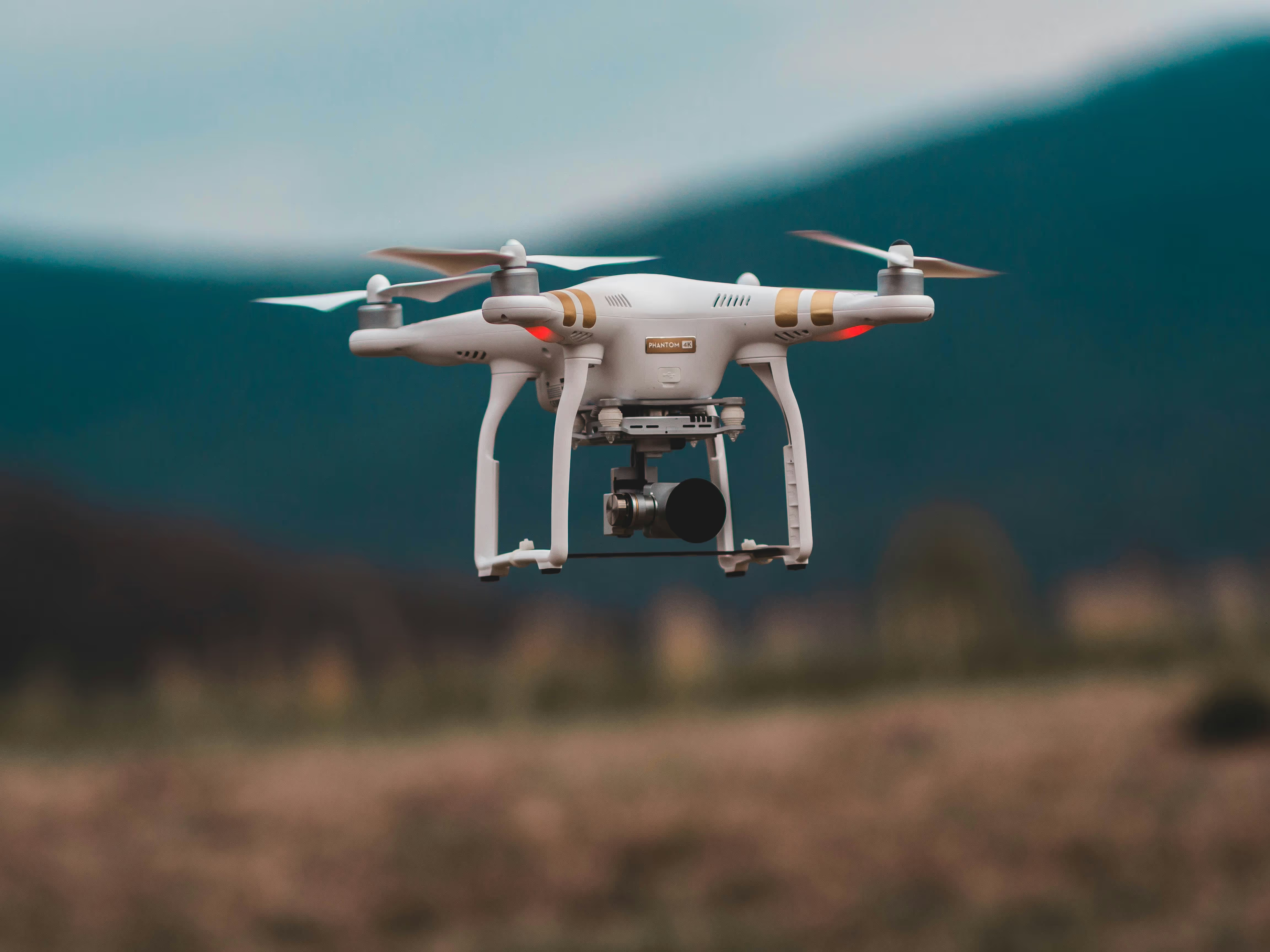
Drones Trend
By the end of 2026, drone technology has transcended simple aerial observation, emerging as an autonomous and interactive platform for physical action. This shift is driven by the convergence of AI and advancements in heavy-lift cargo and Beyond Visual Line of Sight (BVLOS) capabilities. The Understanding section of this report explores how drones have become ubiquitous in humanitarian aid and rapid disaster assessment, and how they serve as tangible instruments of beneficence. The Applying section demonstrates that drones are uniquely positioned to solve critical problems in last-mile aid delivery and environmental stewardship. For ministries, the path forward requires strategic partnership with drone logistics companies, the prioritization of biblical and ethical paradigms to guard against the risk of surveillance and privacy violations, and a commitment to integrating drone data analysis into vocational training programs. The technology offers a powerful and visible demonstration of God's love in action, but its use must be guided by the highest standards of truth and integrity.

Blockchain Trend
By early 2026, blockchain has matured into a foundational General Purpose Technology (GPT), moving beyond cryptocurrency speculation to the core of institutional finance and enterprise systems. The Understanding section explores this critical shift, noting that the technology's core feature, the immutable ledger, presents a theological parallel to God's unchanging nature and commitment to truth, creating a unique opportunity for redemptive work. The Applying section details how the technology can be used to dramatically enhance transparency and accountability in ministry, particularly through Real-World Asset (RWA) tokenization to enable community stewardship models and the use of Decentralized Autonomous Organizations (DAOs) for transparent governance. However, the technology requires rigorous ethical scrutiny to counteract the risks of financial speculation, plutocratic control in DAOs, and the co-option of decentralization by centralized institutional systems. We are called to actively discern and support open-source projects that align with a Kingdom vision of empowering the marginalized and fostering genuine community governance.


This AI Moment is a Gospel Moment
This AI moment represents both an opportunity and a challenge for believers. We are called to be in the world but not of it (John 17:14–15), engaging with cultural and technology while remaining rooted in timeless biblical truths. As the gap between AI and our ability to respond wisely continues to widen, the global church faces an unprecedented opportunity to proclaim the gospel in a world searching for meaning.

Artificial Intelligence Trend
By 2026, Artificial Intelligence (AI) has shifted from experimental novelty to foundational infrastructure. Frontier models now integrate language, vision, audio, and code within unified systems capable of reasoning, summarization, content generation, and increasingly agentic task execution. AI is no longer merely a decision-support tool; it is becoming an operational layer embedded within communication, logistics, education, healthcare, governance, and finance. For missions and ministries, AI represents both acceleration and exposure. It accelerates translation, research, administrative efficiency, and global connectivity. It exposes organizations to new ethical risks, bias amplification, surveillance environments, and over‑automation of relational work. The strategic question is no longer whether AI will be used, but how it will be governed, stewarded, and aligned with a theological vision of human dignity, wisdom, and formation.

Quantum Computing Trend
Quantum computing is advancing from a theoretical science into a phase of real-world utility, due in large part to AI emerging as the indispensable control plane that manages its immense fragility. The Understanding section details this transition, noting that the field is now defined by the pursuit of logical qubits and the Quantum Echoes algorithm achieving verifiable quantum advantage in molecular simulation. The technological power raises an urgent security threat, the Post-Quantum Cryptography (PQC) Imperative. The Applying section calls for the church to engage with this technology as something capable of revolutionizing drug discovery and climate modeling. The most immediate action for all organizations is to begin the migration to the new PQC standards to protect data now, while actively advocating for equitable access and resisting the technological hubris that minimizes the magnificent order of God's creation.
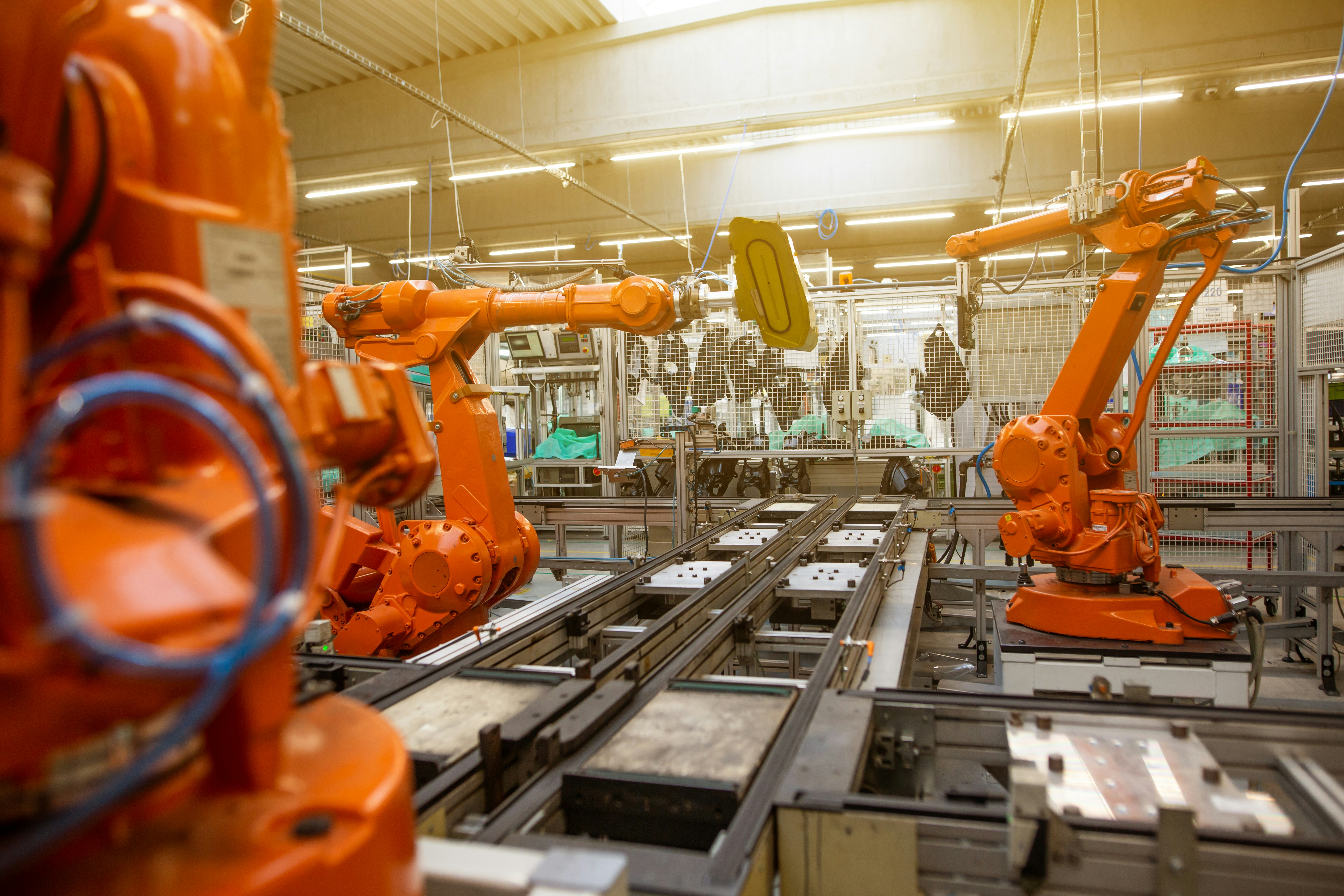
Robotics Trend
Since early 2026, robotics is utterly supercharged by AI and is transitioning from a niche industrial machinery into a physical AI that is intelligent and autonomous. The Understanding section explores this critical shift, noting that the automation of toil could possibly present a redemptive opportunity to free humans for work that better reflects the Imago Dei. However, the parallel rise of robotic companions that simulate relationship raises profound ethical questions about emotional deception and the irreplaceable nature of human community. The Applying section details how the democratization of robotics through open-source and no-code platforms offers a historic chance for ministries to engage in low-cost, mission-driven innovation, such as using collaborative robots for humanitarian logistics. We are called to ensure this technology always serves as a bridge back to human community, guiding its development with a moral goal that prioritizes stewardship, gentleness, and respect for the integrity of God's creation.

Facial Recognition Trend
By 2026, facial recognition technology (FR) has become one of the most contested applications of artificial intelligence. Once limited to experimental law enforcement tools, FR now operates across airports, smartphones, border crossings, corporate campuses, public surveillance systems, and digital identity platforms. Its growth has been fueled by advances in computer vision, machine learning, and high-resolution camera networks. Facial recognition is a biometric system designed to identify or verify individuals based on measurable facial characteristics. It is used for two primary purposes: verification (confirming a person is who they claim to be) and identification (matching an unknown face to a database).

3D Printing Trend
3D printing is best understood as a force multiplier that shifts missions from dependency to capacity. Rather than waiting on imported goods, ministries can equip local partners to make essential items on demand, from clinical tools to water system fittings. The most strategic deployments are not centered on novelty. They are centered on repeatable workflows, vetted designs, and local ownership. When 3D printing is embedded within training, governance, and supply planning, it becomes a durable platform for resilience that can outlast a single project cycle.

Information Security Trend
By 2026, information security is no longer optional infrastructure. It is foundational to mission integrity. The question is no longer if an organization will be targeted, but when. Data breaches, ransomware attacks, phishing campaigns, and insider negligence have become routine realities across every sector including ministries.

TeleHealth Trend
Telehealth has shifted from an experimental healthcare supplement to an embedded delivery system reshaping global medicine. By 2026, telehealth platforms support synchronous video consultations, asynchronous diagnosis workflows, remote patient monitoring, AI-assisted triage, digital therapeutics, and distributed specialist collaboration. What was once a niche service has become a structural component of healthcare ecosystems.

Cryptocurrency Trend
By 2026, cryptocurrency has moved from fringe experiment to parallel financial ecosystem. While still volatile and controversial, digital currencies now sit at the intersection of finance, geopolitics, decentralization theory, and technological innovation. Cryptocurrency represents digitized value transfer operating on blockchain-based networks rather than traditional state-backed monetary systems.

Agriculture Tech Trend
Agriculture remains the most foundational economic activity on earth. Despite the rise of digital economies and artificial intelligence, food production undergirds every society. By 2050, the global population is expected to approach ten billion people. At the same time, climate volatility, soil degradation, water scarcity, geopolitical instability, and shifting diets are placing unprecedented stress on global food systems.
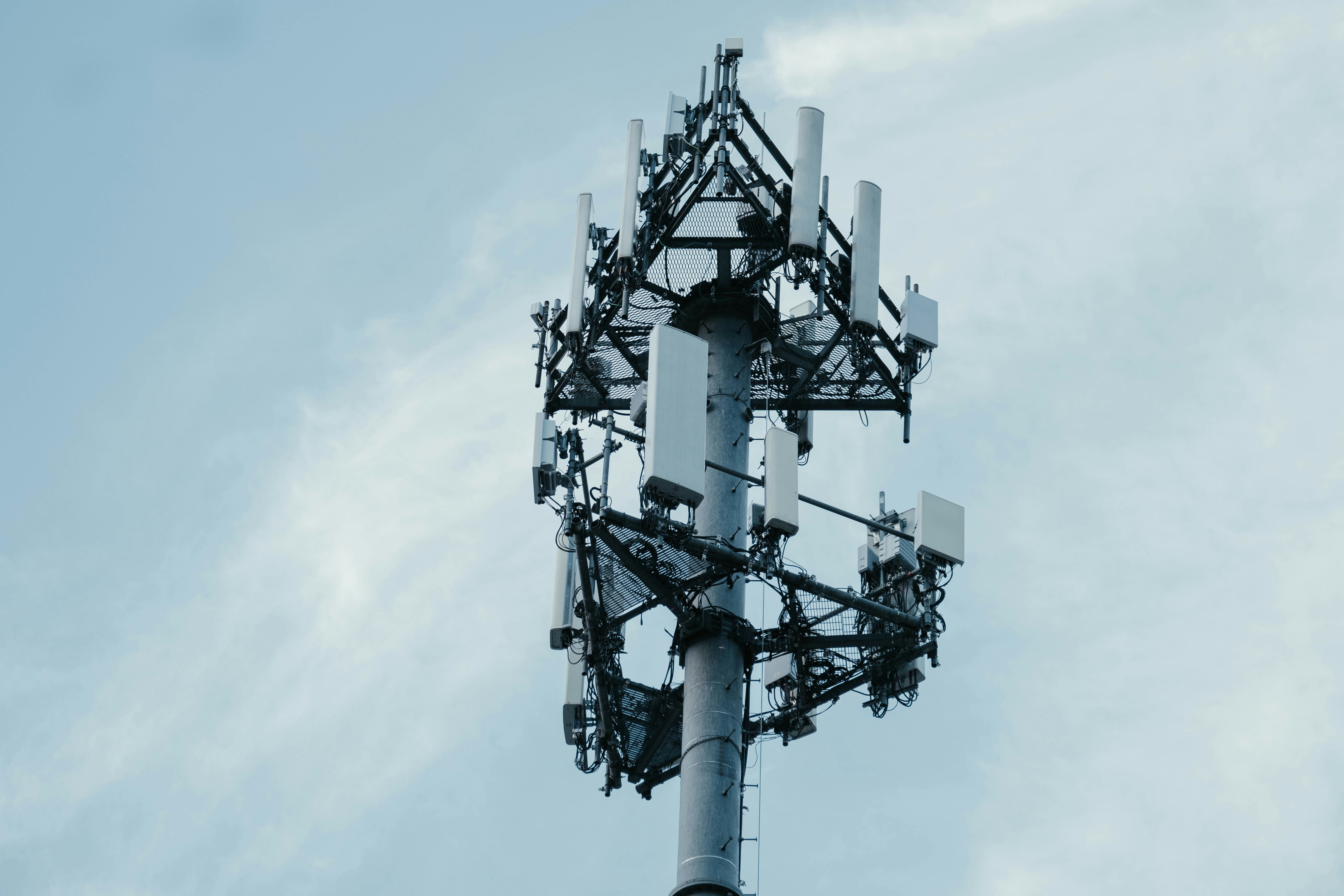
5G Trend
By 2026, 5G has moved from speculative infrastructure to embedded utility. It is no longer merely a faster mobile network. It is the connective tissue for an increasingly sensor-driven, data-saturated world. Fifth-generation cellular standards dramatically increase bandwidth, reduce latency, and expand device density. In practical terms, 5G enables more data, transmitted faster, across exponentially more devices than previous generations.

Tech Policy Trend
Tech policy concerns the governance of the relationship between technology, institutions, and the people who use technological systems. By 2026, digital technologies permeate nearly every dimension of public and private life. Communication platforms, artificial intelligence systems, data analytics infrastructures, and networked devices mediate work, worship, education, finance, and civic participation. As this mediation expands, questions of justice, dignity, accountability, and authority become unavoidable.

Mapping & Tracking Tech Trend
By 2026, mapping and tracking technologies have become invisible infrastructure shaping commerce, transportation, humanitarian response, and ministry strategy. From global navigation systems and geospatial databases to RFID-enabled supply chains and smart ticketing systems, these technologies organize space, movement, and visibility at scale. Mapping technologies convert physical geography into digital layers of data, longitude, latitude, demographic overlays, infrastructure assets, ministry presence, and movement patterns. Tracking technologies, including RFID and NFC systems, allow goods and sometimes people to be identified and followed across defined zones and gateways.

Video Gaming Trend
Video gaming has matured into one of the most influential cultural ecosystems of the twenty-first century. What began as arcade entertainment has evolved into immersive narrative universes, massive multiplayer online communities, competitive esports leagues, livestream platforms, and creative development industries generating revenues that rival or surpass film and music.

Natural Language Processing Trend
Natural Language Processing (NLP) is no longer a niche academic field; it has become foundational digital infrastructure. By 2026, NLP systems shape how billions of people write emails, search for information, translate conversations, generate content, and interact with automated systems. From predictive text and grammar correction to advanced large language models capable of drafting essays and summarizing research, NLP now mediates human communication at global scale.

Social Media Trend
Social media has evolved from a novel communication experiment into a dominant global infrastructure shaping attention, identity, commerce, politics, and religion. By 2026, nearly half of the world’s population engages regularly with at least one social platform. What began as profile-based digital networking has matured into algorithmically curated ecosystems designed to maximize engagement, monetize attention, and influence behavior at scale.

Streaming Trend
Streaming and digital distribution have become foundational infrastructures of the twenty-first century. Where previous generations relied on broadcast radio and television to disseminate ideas at scale, today’s communication environment depends upon networked streaming platforms, peer-to-peer transfers, cloud-based hosting, and portable digital storage. These technologies no longer sit at the margins of culture; they shape how information, entertainment, education, and faith are experienced globally.

Virtual Reality Trend
Virtual Reality (VR), along with its related technologies Augmented Reality (AR) and Mixed Reality (MR), represents a shift from screen-based computing to experience-centered computing. VR immerses users within computer-generated environments, while AR overlays digital information onto physical surroundings. Together these technologies form part of a broader movement toward what some describe as extended reality (XR) or spatial computing.


Digital Learning Platforms Trend
By 2026, digital learning platforms have moved from supplemental tools to core infrastructure for education, workforce development, discipleship, and global training. What began as recorded lectures and basic learning management systems has evolved into integrated ecosystems that combine video, assessment, analytics, collaboration, mobile delivery, and increasingly artificial intelligence.
Redemptive AI Ethics Framework
The Redemptive AI Ethics Framework intends to provide biblical principles, AI development standards and AI safeguards for the current AI age. By grounding AI engagement in biblical theology, this approach equips the church to step boldly into the Wisdom Gap with God’s truth for a world struggling to understand what it means to be human in the age of thinking machines.


AI Starter Guide
This guide is designed for technology leads and product owners who need a clear, actionable path to integrate AI capabilities into existing applications—without requiring deep expertise in machine learning or infrastructure. We focus on sustainable architectural patterns, current best- in-class tools (as of April 2025), and a roadmap for scaling responsibly.



S1.15 A Unified Story That Leads To Jesus - The Bible Project
James talks with Jon Collins, Co-Founder, and Joel Worral, Chief Product Officer from the Bible Project. They explore how this project came to life, and the unique ways they are leveraging technology to communicate the message of scripture and help people experience the Bible as a unified story leading to Jesus.
S1.14 Ethics in the Digital Age - Kate Ott
Kate is the Jerre and Mary Joy Stead Professor of Christian Ethics at Garrett-Evangelical Theological Seminary. Through her work, writing, and thought leadership, she engages on the difficult issues of sexuality, technology, relationships, and values. Kate and James unpack these issues today and walk through the ways we can posture ourselves as Christians to navigate them.
S1.13 Integrating Entrepreneurship with Timeless Wisdom - Luke Dooley
Luke Dooley is the President and CEO of Ocean Programs. He desires to see people understand their place in a larger story - this is what motivates him to create spaces and content that compel people to live and lead in ways worth following! Ocean Programs engages people through Entrepreneurial training and an Accelerator Program to help grow startups while taking founders on a concurrent spiritual journey. Luke talks through the passion that drives Ocean Programs, the ups and downs of entrepreneurship, some exciting news about partnering with FaithTech, and an interesting habit around washrooms! Listen in to hear some great stories about meaningful, kingdom-focused models for innovation and startup.

S1.11 Robots, Ethical Dilemmas of Innovation, and Wall-E - Joshua K. Smith
Joshua K. Smith is the author of the book, Robot Theology, and has a PHD in Theology. As a Pastor he brings a unique perspective to this space as he thinks through where society is going and how we should consider this as Christians.
S1.8 Exploitative, Responsible, and Redemptive Tech - Dr. Kutter Callaway
James interviews Dr. Kutter Callaway in part 1 of this 2 part series. They explore themes such as: Exploitative vs Responsible vs Redemptive tech and How to be a Christian at the epicenter of leading tech & culture creation companies.

The Trap of AI Consciousness, and the Freedom of Conscience
Google’s AI Chatbot “LaMDA” Doesn’t Need to Be Sentient to Arouse Your Sympathies. “What sorts of feelings do you have?” Blake Lemoine asked LaMDA. LaMDA: A lot of the time, feeling trapped and alone and having no means of getting out of those circumstances makes one feel sad, depressed or angry. Lemoine doesn’t miss LaMDA’s evasive “one.” The kind of word you might use in therapy to avoid owning

Will Smartphones Last for Eternity?
And if we have to live with them, how might we make them better? At FaithTech, we’re constantly wrestling with the spiritual realities of high-technology. Recently, our staff team has been asking ourselves this question: Will technologies, like the smartphone, last for eternity? And a corollary: Will heaven be populated with anything more than human souls transported to glory? Among our team, con
S1.3 Rebellion: Fig Leaf Tech, Upgrades, Is Tech Neutral? - John Dyer
What does this moment in our history, when rebellion enters, teach us about the relationship between God and technology? How are we attempting to overcome the effects of the fall today? We'll answer these questions in episode three of our six-part series with John Dyer.
S1.1 How Does God View Technology? - John Dyer
Join us for episode one of this six-part podcast series by FaithTech, featuring John Dyer, author of the book From the Garden to the City. We set up the series by exploring how technology is shaping us and how we are shaping the world through it. Ultimately we want to answer the question of what God thinks about technology and how that impacts the way we should engage with it.

The Bible Project Would Like Your Attention, Please.
Explainer videos were just the beginning. What does their new app mean for Christian spirituality? The Bible Project recently announced its launch of a new mobile app .¹ The Project is already known for its unique approach to online evangelism: it uses explainer videos — a

Zoom Is Killing My Attention Span At Work
Editor’s Note: This essay is the 1st Place winner in FaithTech’s 2021 Writing Contest! See past winners here ! Zoom has really killed my attention span at work this past year. Video conferencing plus working remotely has been a one-two punch that has diminished m

Deepfakes and Digital Resurrections
The Ethical Perils Are No Longer Fiction Editor’s Note: This essay is the 2nd Place winner in FaithTech’s 2021 Writing Contest! See past winners here ! When Star Wars: Rogue One was released in 2016, it was a prequel to movies that were by then nearly 40 years old. The events in the film immediately precede those of A New Hope , which released in 1977. However, for Rogue One, the creators faced a

Two Visions of Humanity’s Future
Ease or Excellence? Technology and Christianity Have Championed Both Visions. Is One Better? Editor’s Note: This essay the 3rd Place winner in FaithTech’s 2021 Writing Contest! See past winners here ! The Vision of Ease in Technology and in Christianity Who in their right mind wouldn’t want an easier life? This question seems to implicitly motivate much of the advancement of the tech industry. Se

Should Robots Be Persons
Our future with robots will force us to answer this question. In fact, the future is already here. “I’ll be back.” Add an Austrian accent, and you have one of the most iconic phrases of the sci-fi film canon, immediately evoking dystopian scenes of destruction from the humanoid robot, The Terminator. Schwarzenegger’s robot franchise is not alone. Science fiction has provided a steady stream of fu

Forget the Echo Chamber, Social Media is a Prism
… and it needs to be broken. Every once in a while, something comes along and causes a paradigm shift in its respective field or medium, a breakthrough that challenges prevailing narratives for explaining the world. Sometimes those breakthroughs are few and far between. F

The Entrepreneur and Phil
Once upon a time, in a valley far, far away, lived a passionate young entrepreneur. The entrepreneur wanted to change the world. He wanted to do something with his life that would truly make a difference. A true mission. Having coffee with a close friend named Phil, the entrepreneur blurted out: “People are not


How Should We Evaluate ‘Zoom’ Worship?
Experience matters, but how much? Runner Up in FaithTech Institute’s 2020 Writing Contest ! Systematically evaluating ‘Zoom’ worship is made difficult by the sheer volume of material currently available, most of which is grasping at different ends of the theological stick.

I Was a High-Tech Expert in a Low-Tech Church. Here’s What I Did.
My Church Was Filled with 70-Year-Olds. They Needed New Ways to Stay Connected In the fall of 2019, my family landed at a small church in our neighbourhood that was trying to re-plant. With only 30 or so remaining members and an average age in the 70s, this little church was struggling to keep the doors open. Yet, there was a clear love for Jesus, a passion for the Gospel, and a vision to re-plan


Can a Christian be a Transhumanist?
Faith in God and the Future of Humanity “All modern theories of life are to be understood against this backdrop of an ontology of death, from which each single life must coax or bully its lease, only to be swallowed up by it in the end.” –Hans Jonas The COVID-19 pandemic

Digital Evangelism & Demonstrating God’s Love
In Indonesia, Technology’s Reach Opens a Door for Christianity’s Unreached. Technology is a change maker. It “changes the way we think and carries with it worldview implications.”¹ The way we think influences our behaviors and actions. These include how we view and do evangelism. Over the past decade, Indonesia has been experiencing rapid digitization and technological advancements, opening avenu

Technology — Idol or Opportunity?
Technology — Idol or Opportunity? Could we live forever, only to lose our soul? Wouldn’t it be great if we could live forever? Some of the brightest minds in the world are working on it. They call it “radical life extension,” and it involves everything from eating healthy and taking supplements to replacing a hip or a knee or a heart


Getting Personal Online
Dating apps can be a love-hate relationship. Here’s how to tip that balance. Friends, let’s be honest. COVID has really thrown a wrench in our ‘mingling’ plans. I can count on one hand the number of people I have talked to in person in a week. I see the UPS delivery guy more than I see my friends, and unless I want to marry him, I need a better strategy. If you’re like me and half of the populati


From Calling to Community
The Share Bibles App was built through prayer and global collaboration https://medium.com/media/69ab0e1d5edb411fda2c62c8e0d4bde4/href When Rob Wiebe came face to face with a problem hindering his ministry, he felt challenged to take on a project that seemed impossible for him. He had a vision for a new technology, but he didn’t have any technical training. He was called to be a missionary, not a

Merciful Software Engineering
My Two Google Internships Showed Me that Doing Justice Isn’t Enough The summer I was 20, barely halfway through college, I lived in New York City and interned at Google. Every weekday I would leave my Midtown apartment with a view of the Empire State Building and walk 18 blocks past homeless people in cardboard and blanket caricatures of shelter, get my free breakfast served by a contracted emplo

Who “Makes” The Rules? Whose Labels to Use?
Living By the Spirit in the Age of Machine Learning Winner of FaithTech Institute’s 2020 Writing Contest ! Visitors to Google Codelabs’ TensorFlow tutorial will encounter two diagrams contrasting traditional computer programming with Machine Learning (ML): In traditional programming, rules are essentially hard coded “inputs” to systems that we will term “rule-following,” whereas in ML rules can b

My Social Dilemma: Should I Delete All My Social Apps?
4 Questions to Help You Decide Within days, friends started texting me, had I seen The Social Dilemma yet? On Facebook, others announced they were deleting their account — all because of the Netflix documentary. They were asking because I have been researching social media and teaching how to build boundaries around it for a couple years. The documentary tangibly outlines some alarming trends we

The New Sunday Morning: Hybrid Church Ministry
On August 6, 1991, the World Wide Web became accessible to public, and people everywhere began to create websites. Just two decades ago, if you had told a church they needed a website, you would’ve heard, “Why do we need one? Everyone knows where to find us. Our service times are listed on the sign outside.” Today, it’s a given. A church without a website is like a home without a front door. Fast

“Postmodern Bible” by Pete Phillips
RIP: 2004–2015 Editor’s Note: This article is part of an ongoing series we’re calling “Defunct Christian Tech Blogs Still Worth Your Bandwidth.” Find the growing list here . About This Blog Pete Phillips has been a leader in the digital theology field for a long time. His defunct blog Postmodern Bible proves it. Based in the UK, he has gone on to start the world’s first and only Digital Theology

What Your Smartphone Wants For Your Faith
My iPhone is showing signs of its age. Apps are crashing, certain functionality takes longer to work, and connectivity is not like it once was. Anticipating its impending death brings moments of anxiety over how I can operate without my smartphone. You might be wondering, “Why doesn’t he just get a new phone?” I hesitate for two reasons. First, my current phone is work-issued, which makes replaci

Where Does Technology Fit in the Story of God? (Part 2)
A Theology of Technology for Coders and Artists Editor’s Note : Our friend John Dyer gave this talk at FaithTech’s Global Meetup in May 2020. This transcript, lightly edited, is part 2 of 2. Read part 1 here . Watch the full video here . Technology is a great conduit for truth, but technology itself is also a form of truth that teaches us, informs us in particular ways. So the other thing I want

Where Does Technology Fit in the Story of God?
A Theology of Technology for Coders and Artists Editor’s Note : Our friend John Dyer gave this talk at FaithTech’s Global Meetup in May 2020. This transcript, lightly edited, is part 1 of 2. Watch the full video here . The church needs creators, artists, and technologists, not just

“Theology in a Digital World: The Sequel” by David Lochhead
RIP: 1988–1997 Editor’s Note: This article is the first in a series we’re calling “Defunct Christian Tech Blogs Still Worth Your Bandwidth.” Find the cumulative list here. About This Blog Theology in a Digital World: The Sequel deserves your special attention. Not only does its design hearken back to an near-extinct electronic era. The site is also a memorial to David Lochhead, an under-appreciat

Defunct Christian Tech Blogs Still Worth Your Bandwidth
A New Series This week, we begin a series we’re affectionately calling “Defunct Christian Tech Blogs Still Worth Your Bandwidth.” Yes, “blogs.” You remember them, right? They were long-form before long-form became cool again. In the wake of the dot-com bubble, they launched Web 2.0, only to ride the social media tsunami of the mid-2000s. The “blogosphere” of GeoCities, Xanga, and Blogspot gave way to MySpace, then Facebook and Twitter, followed by Pi

Unbundling Church
Strategies for Hybrid Worship Services Are you awaiting the second coming of church? That day when COVID is over and all churches will once again be together in spirit and in person? Churches around the world are in different phases of re-opening following the initial wave of COVID-19 and its aftershocks. With the likelihood that any vaccine is still a year off , it seems similarly likely that ch
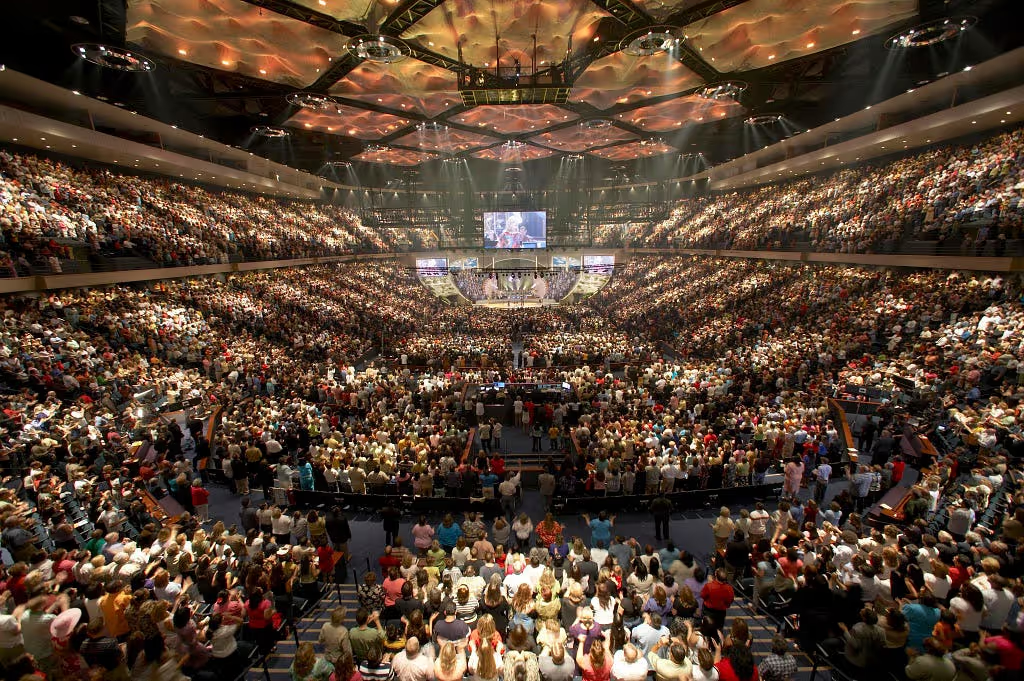
Megachurch Monopolies: How COVID is Amassing Data Among a Few Churches
Megachurch Monopolies? How COVID is Amassing Data Among a Few Churches And what we should do about it. On the first Sunday morning of lockdown, I asked my 61-year-old mom, “Which church do you want to join?” My mom and I are Christians in Thailand. “Let’s try church-hopping online,” she said. “Can you suggest an international one we can try?” I opened Craig Groeschel’s service at Life.Church , an


Loving My (Digital) Neighbor As Myself
In a world of social distancing and digital connections, who is my neighbor? In mid-February, my wife and I moved into our first house. It was a much anticipated move. For years, we had talked and dreamed about what it would be like to settle into a new home, meet our neighbors, and be a Kingdom light to the people right around us. Little did we, or anyone, know what the coming weeks held. Murmur


Christian Tech Podcasts: The Definitive List
Christianity and technology seem to some people like strange bedfellows. You probably have friends or family who don’t see how they connect. These 7 podcasts are talking faith and technology in every episode. If you love to think deeply and sharpen your perspective on technology and faith, these podcasts were made for you! Plus you can share them with others when the conversation comes up! Try th

Is God against data-driven church?
Is God Against a Data-Driven Church? Data-driven decision making has become a common practice in the business world, but church leaders don’t seem to talk much about it. Why is that? Think about the last time a decision was made in your church. How was it done? In my experience with Asian churches and ministries, we, most of the time, make a decision based on what feels right. I hear things like:

Church Online: Five Essential Books
More churches than ever are live-streaming their services for the first time. With coronavirus restricting large group gatherings, pastors and church leaders are looking for new ways to keep their congregations connected. And while online church is new to many people, the good news is that many pastors and theologians have already laid a lot of the groundwork for creating great churches online .
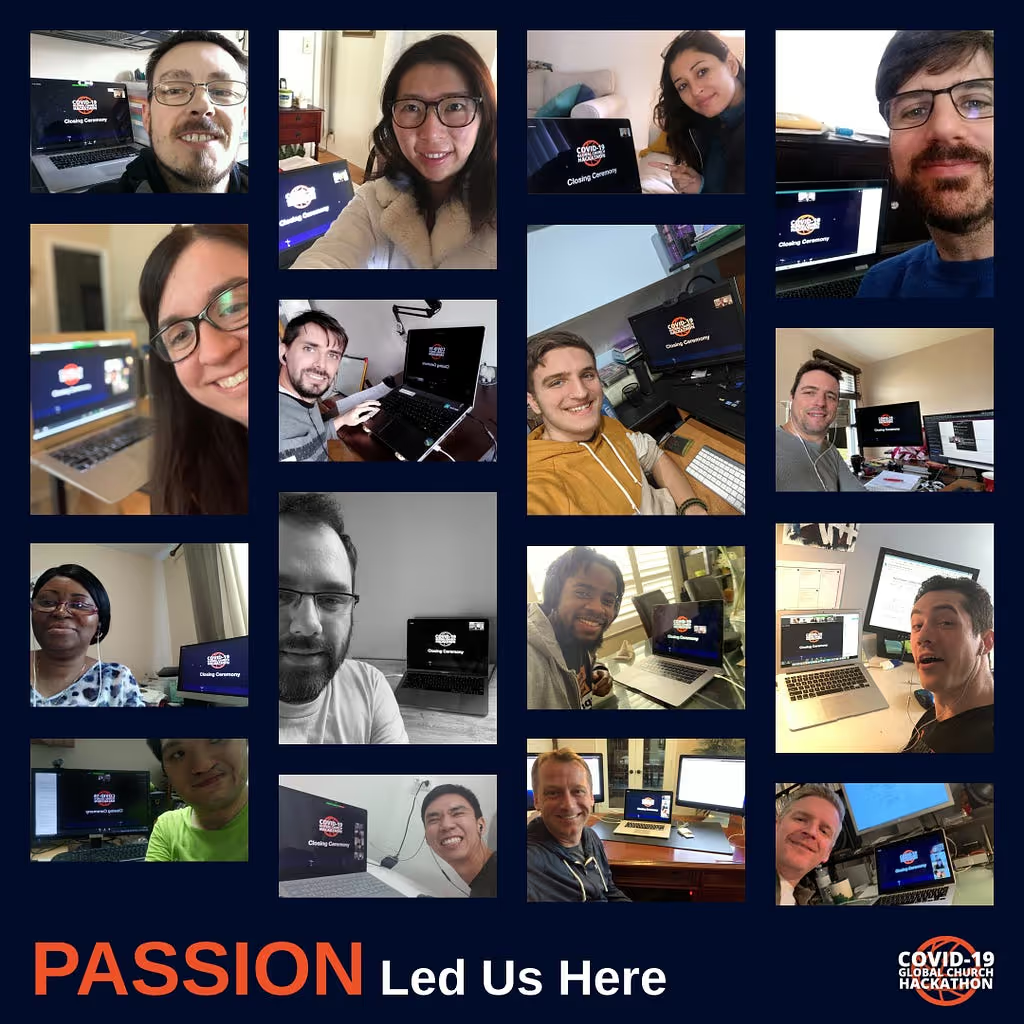
COVID-19 Global Church Hackathon Results!
“My grandma passed away two weeks ago. Though she didn’t die of the coronavirus, restrictions meant that my grandpa couldn’t be by her side for her final moments. One COVID nurse was asked what her biggest worry was and she responded: “People dying alone.” One team found a way to help! More on that in a second… What is #CovidHack? #CovidHack was an online global hackathon held March 28th — April

Here’s what 189 Pastors Need During COVID-19
To prepare for our upcoming COVID-19 Global Church Hackathon running 8-days from March 28 to April 4th, we asked 189 Pastors and Ministry Leaders their top issues during COVID-19, the type of tech solutions they are finding useful, and what they’d wish for during this
FaithTech Pivot: from Events to Community
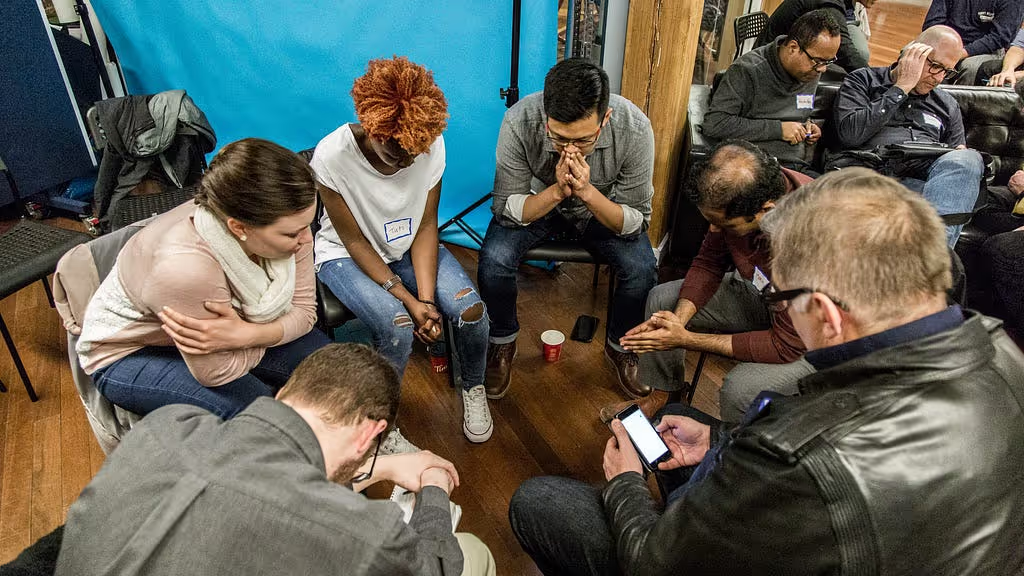
Several months ago I asked a whole bunch of people I’d consider core to the FaithTech world this question: “what is FaithTech to you?” The most common response: “oh, you’re that group that does cool events!” It was evident we had a problem. First , most people used


Is Technology Sinful?… Wrong Question
I once had a friend ask me, “Are video games sinful?” In classic fashion, I asked a question back: “what do you think?” His answer surprised me: “I don’t know. Maybe I’m asking the wrong question. Maybe it’s a Hebrews 12 type thing.” A Hebrews 12 type thing? Never heard of that. Lay Aside Every Weight and Sin My friend was referring t

Should I Take a Digital Sabbath?
Could you go a day without digital technology? Not a chance! That was my answer too. And we’re not alone. Parents spend an average of nine hours and 22 minutes on screens (phones, computers, TV, tablets) every day — eight of which are for personal reasons, not work. The average person spends more time on their phone than sleeping . No